
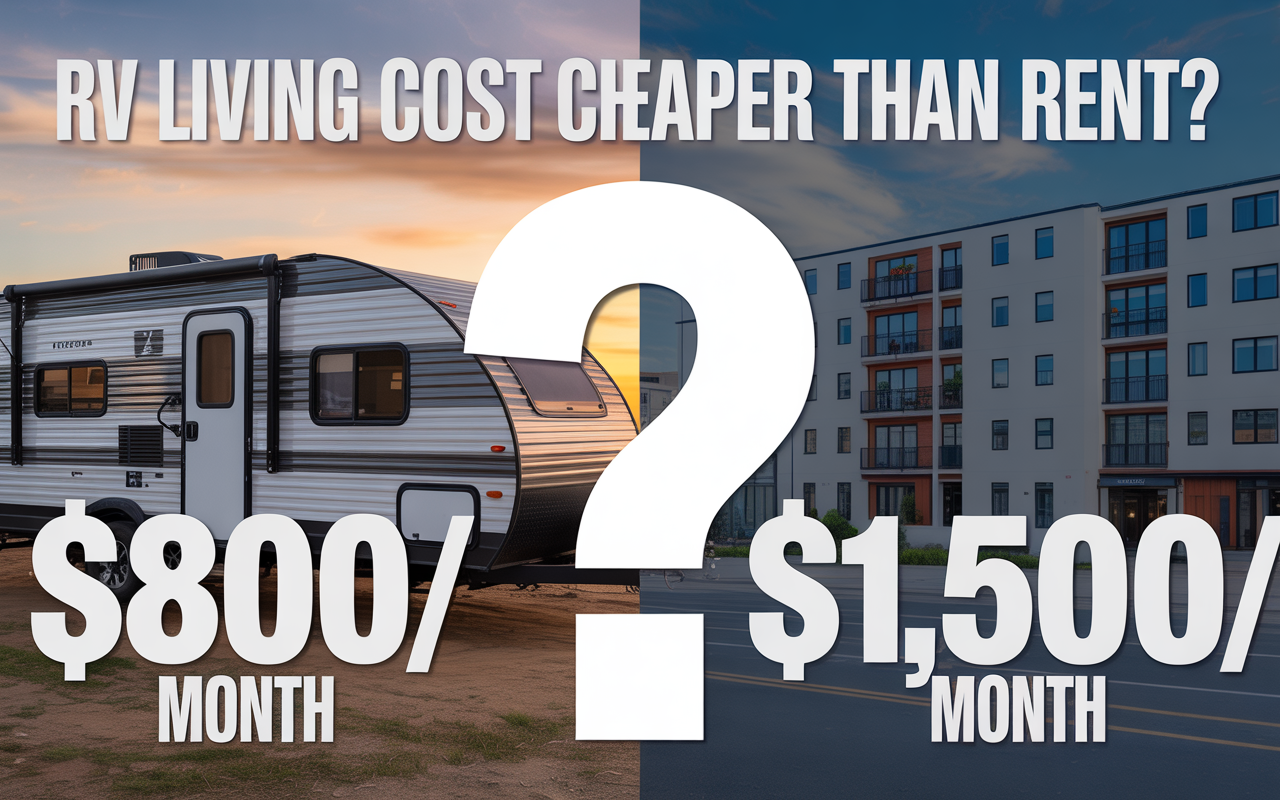
The Real Cost of RV Living in 2026: Is It Actually Cheaper Than Rent?
The dream of hitting the open road, waking up to a new vista every week, and ditching the traditional rent payment has never been more alluring. With housing costs continuing to climb and remote work becoming a permanent fixture for many, RV living is presented as a liberating and financially savvy alternative. But as we move into 2026, the economic landscape has shifted. Is trading a stationary apartment for a mobile home actually a path to savings, or a financial sinkhole disguised in wanderlust? Let’s break down the real, comprehensive cost of RV living in 2026 and compare it head-to-head with the cost of renting a traditional apartment.
The Allure: Why People Think RV Living is Cheaper
The math seems simple at first glance. The national average monthly rent for a one-bedroom apartment in the U.S. is projected to hover around $2,200 in 2026. Meanwhile, you can find a seemingly decent used travel trailer for $20,000 or a new Class B van for $80,000. A quick loan calculation makes a $500-$800 monthly payment look like a steal compared to rent.
This surface-level comparison fuels the dream. Proponents tout escaping property taxes, high utility bills, and the rigidity of a lease. The narrative is one of freedom, both geographical and financial. However, this initial calculation ignores the vast ecosystem of recurring and unexpected costs that come with making an RV your primary home. It’s not an apples-to-apples comparison; it’s more like comparing the cost of owning a car to the cost of using a comprehensive public transit system.
The True Cost Breakdown of Full-Time RV Living in 2026
To understand the real financial commitment, we must look beyond the loan payment. Here are the major cost categories for a full-time RVer in 2026.
1. The RV Itself: Depreciation is a Beast
Your RV is not a home that appreciates; it’s a vehicle that depreciates—rapidly.
- Purchase Price & Financing: A new mid-range travel trailer might cost $40,000, while a new diesel motorhome can easily exceed $150,000. Interest rates on RV loans are typically higher than mortgages, often between 6-9% in 2026.
- Depreciation: Expect a new RV to lose 20-30% of its value the moment you drive it off the lot and up to 50% within the first three years. This is a massive hidden cost that renters don’t face.
- Example: You buy a new Class C RV for $80,000. In three years, it might only be worth $40,000. That’s a $40,000 loss (or over $1,100 per month) in addition to your loan payment.
2. Your Patch of Dirt: Campground & Membership Fees
Unless you plan on boondocking (dry camping for free) 100% of the time, you’ll pay for a place to park.
- RV Parks & Campgrounds: In 2026, nightly rates at desirable parks with full hookups (water, sewer, electric, WiFi) range from $60 to $120+. Monthly rates offer a discount but still vary widely: $600-$1,500 in the Southwest, and $1,200-$2,500+ in popular coastal areas or near cities.
- Membership Clubs: Clubs like Thousand Trails offer “free” camping for an annual fee (around $700 in 2026). However, their popular zones are often booked months in advance, and there are strict stay limits, making them a supplement rather than a total solution.
- Boondocking: Free on public lands (BLM, National Forests) is a key budget strategy. But it requires significant investment in solar power, large water tanks, and a means to manage waste. It also often means being far from amenities and services.
3. Fuel: The Budget Wildcard
This is one of the most volatile and impactful costs.
- Fuel Costs: With a motorhome or a large truck towing a fifth wheel getting 8-15 miles per gallon, a single long-distance move can cost hundreds of dollars. At $4.50-$5.25 per gallon for diesel/gas in 2026, frequent travel is a major expense.
- The Travel Style Impact: The “see it all” traveler covering thousands of miles a month will have a fuel bill rivaling a high rent payment. The “slowmad” who moves every 2-4 weeks will contain this cost significantly.
4. Maintenance & Repairs: The Inevitable
An RV is a house shaken by an earthquake daily, mounted on a vehicle chassis. Things break.
- Regular Maintenance: Engine/oil changes (for motorhomes), tire replacements (RV tires age out every 5-7 years regardless of mileage, costing $2,000+), roof sealant, and appliance servicing.
- Repairs: A leaky roof, a failed water heater, or an awning damaged by wind can cost anywhere from $500 to $5,000. Setting aside $150-$300 per month into a dedicated repair fund is considered essential, not optional.
5. Insurance & Registration
- Insurance: Full-time RV insurance (different from recreational coverage) for a moderately priced rig can run $1,500-$3,000 annually in 2026, depending on coverage, driving history, and domicile state.
- Registration: Annual vehicle registration fees vary by state but are typically higher than for a standard car.
6. Utilities & Connectivity
- Propane: Used for heating, cooking, and refrigeration while off-grid. Cost varies with season and climate.
- Mobile Internet: This is a non-negotiable for remote workers. A robust setup using cellular boosters and multiple data plans (e.g., from Starlink and a cellular provider) can cost $150-$250 per month.
- Laundry: Most RVers use campground laundromats, costing $40-$80 monthly.
7. Domicile & “Hidden” Life Admin
Full-timers must establish a legal domicile state for taxes, voting, and vehicle registration. This often requires using a mail forwarding service ($150-$300/year) and may involve trips to that state for driver’s license renewal. Healthcare and insurance networks become more complex when you’re constantly moving.
The 2026 Renter’s Reality: A Simpler Equation
For a renter in 2026, the cost structure is far more predictable:
- Monthly Rent: The primary fixed cost ($2,200 national average, but highly location-dependent).
- Utilities: Often an additional $150-$300 for electricity, gas, water, sewer, and trash.
- Renter’s Insurance: ~$20-$30 per month.
- Commuting Costs: Gas, public transit, or vehicle wear-and-tear.
The renter’s huge advantages are predictability and passed-on liability. The landlord is responsible for the roof, major appliance failures, property taxes, and exterior maintenance. Your maximum monthly exposure is largely known.
Side-by-Side: Two Scenarios for 2026
Let’s compare two realistic, moderate budgets for a single person or couple.
Scenario A: The “Moderate Slowmad” RVer
- RV Loan Payment (on a $50k used trailer): $450
- Truck Payment (to tow it): $500
- Campground Fees (avg. $900/mo): $900
- Fuel (moving every 3 weeks): $350
- Maintenance/Repair Fund: $250
- Insurance (RV & Truck): $200
- Mobile Internet & Utilities: $225
- Estimated Monthly Total: ~$2,875
Scenario B: The Urban Renter
- One-Bedroom Apartment Rent: $2,200
- Utilities (Elec/Gas/Internet): $275
- Renter’s Insurance: $25
- Commuting/Car Gas: $200
- Estimated Monthly Total: ~$2,700
Key Factors That Tilt the Scale
The above scenarios reveal a near-parity, but these factors decide which life is truly “cheaper”:
- Travel Style: The RVer who boondocks 75% of the time and rarely moves could slash their cost to $1,800 or less. The constant traveler could exceed $4,000 easily.
- DIY Skills: An RVer who can fix their own plumbing, electrical issues, and engine problems saves thousands annually.
- Initial Purchase: Paying cash for a used, well-inspected RV eliminates a loan payment, dramatically changing the math.
- Location, Location, Location: A renter in a high-cost city (NYC, SF) paying $3,500+ for a studio makes even a lavish RV life look affordable. A renter in a Midwest town paying $900 has a very high bar to beat.
The Intangible Costs & Benefits
The financials are only half the story.
- RV Living Offers: Priceless experiences, nature, community, freedom, and adventure. Your “backyard” can be a national park.
- RV Living Demands: Constant problem-solving, logistical hassle, smaller living space, potential isolation, and the stress of major breakdowns.
- Renting Offers: Stability, space, community roots, and simplicity. You can forget about your home when you leave for work.
- Renting Demands: Lack of control over rent increases, less connection to nature (in cities), and the feeling of “paying someone else’s mortgage.”
Conclusion: It’s Not Cheaper—It’s Different
So, is RV living actually cheaper than rent in 2026? The clear answer is: not inherently, and rarely by accident.
For most people, achieving a financially sustainable RV life requires meticulous budgeting, a significant upfront investment (either in cash or high monthly payments), and a commitment to a specific, often frugal, travel style. It is not a simple hack to escape high rent; it’s a trade-off where you exchange a predictable housing cost for a variable lifestyle cost, and take on the role of landlord, mechanic, and logistics manager.
RV living can be comparable to renting in a mid-tier city and can be significantly cheaper if you master boondocking and minimize travel. Conversely, it can be far more expensive if you desire resort-style parks, constant cross-country travel, and a new motorhome.
Ultimately, the decision shouldn’t be driven solely by a presumed cost savings. Choose RV living if you crave the lifestyle, the adventure, and the challenge, and you are willing to architect your finances to support it. Choose renting for its simplicity, predictability, and stability. In 2026, both are valid paths—one is not universally cheaper, but one might be infinitely richer for you.